Wednesday, April 28, 2010

Automotive industry

The costs of automobile usage, which may include the cost of: acquiring the vehicle, repairs, maintenance, fuel, depreciation, parking fees, tire replacement, taxes and insurance,[23] are weighed against the cost of the alternatives, and the value of the benefits - perceived and real - of vehicle usage. The benefits may include on-demand transportation, mobility, independence and convenience.[9]

Similarly the costs to society of encompassing automobile use, which may include those of: maintaining roads, land use, pollution, public health, health care, and of disposing of the vehicle at the end of its life, can be balanced against the value of the benefits to society that automobile use generates. The societal benefits may include: economy benefits, such as job and wealth creation, of automobile production and maintenance, transportation provision, society wellbeing derived from leisure and travel opportunities, and revenue generation from the tax opportunities. The ability for humans to move flexibly from place to place has far reaching implications for the nature of societies.

History of the automobile

Ferdinand Verbiest, a member of a Jesuit mission in China, designed a steam-powered vehicle around 1672. It was a 65 cm-long scale-model toy for the Chinese Emperor, that was unable to carry a driver or a passenger, but possibly was the first working steam-powered vehicle ('auto-mobile').[7][8][9] It is not known if Verbiest's model was ever built.[8]

Leonty Shamshurenkov, a Russian peasant, constructed a human-pedalled four-wheeled "auto-running" carriage in 1752, and subsequently proposed to equip it with odometer and to use the same principle for making a self-propelling sledge.[10]

Although Nicolas-Joseph Cugnot is often credited with building the first self-propelled mechanical vehicle or automobile in about 1769, by adapting an existing horse-drawn vehicle, this claim is disputed by some[citation needed], who doubt Cugnot's three-wheeler ever ran or was stable. What is not in doubt is that Richard Trevithick built and demonstrated his Puffing Devil road locomotive in 1801, believed by many to be the first demonstration of a steam-powered road vehicle, although it was unable to maintain sufficient steam pressure for long periods, and would have been of little practical use.

In the 1780s, a Russian inventor of merchant origin, Ivan Kulibin, developed a human-pedalled, three-wheeled carriage with modern features such as a flywheel, brake, gear box, and bearings; however, it was not developed further.[11]

François Isaac de Rivaz, a Swiss inventor, designed the first internal combustion engine, in 1806, which was fueled by a mixture of hydrogen and oxygen and used it to develop the world's first vehicle, albeit rudimentary, to be powered by such an engine. The design was not very successful, as was the case with others, such as Samuel Brown, Samuel Morey, and Etienne Lenoir with his hippomobile, who each produced vehicles (usually adapted carriages or carts) powered by clumsy internal combustion engines.[12]

In November 1881, French inventor Gustave Trouvé demonstrated a working three-wheeled automobile that was powered by electricity. This was at the International Exhibition of Electricity in Paris.[13]

Although several other German engineers (including Gottlieb Daimler, Wilhelm Maybach, and Siegfried Marcus) were working on the problem at about the same time, Karl Benz generally is acknowledged as the inventor of the modern automobile.[12]

An automobile powered by his own four-stroke cycle gasoline engine was built in Mannheim, Germany by Karl Benz in 1885, and granted a patent in January of the following year under the auspices of his major company, Benz & Cie., which was founded in 1883. It was an integral design, without the adaptation of other existing components, and included several new technological elements to create a new concept. This is what made it worthy of a patent. He began to sell his production vehicles in 1888.

Karl Benz
A photograph of the original Benz Patent Motorwagen, first built in 1885 and awarded the patent for the concept

In 1879, Benz was granted a patent for his first engine, which had been designed in 1878. Many of his other inventions made the use of the internal combustion engine feasible for powering a vehicle.

His first Motorwagen was built in 1885, and he was awarded the patent for its invention as of his application on January 29, 1886. Benz began promotion of the vehicle on July 3, 1886, and about 25 Benz vehicles were sold between 1888 and 1893, when his first four-wheeler was introduced along with a model intended for affordability. They also were powered with four-stroke engines of his own design. Emile Roger of France, already producing Benz engines under license, now added the Benz automobile to his line of products. Because France was more open to the early automobiles, initially more were built and sold in France through Roger than Benz sold in Germany.

In 1896, Benz designed and patented the first internal-combustion flat engine, called a boxermotor in German. During the last years of the nineteenth century, Benz was the largest automobile company in the world with 572 units produced in 1899 and, because of its size, Benz & Cie., became a joint-stock company.

Daimler and Maybach founded Daimler Motoren Gesellschaft (Daimler Motor Company, DMG) in Cannstatt in 1890, and under the brand name, Daimler, sold their first automobile in 1892, which was a horse-drawn stagecoach built by another manufacturer, that they retrofitted with an engine of their design. By 1895 about 30 vehicles had been built by Daimler and Maybach, either at the Daimler works or in the Hotel Hermann, where they set up shop after disputes with their backers. Benz and the Maybach and the Daimler team seem to have been unaware of each other's early work. They never worked together because, by the time of the merger of the two companies, Daimler and Maybach were no longer part of DMG.

Daimler died in 1900 and later that year, Maybach designed an engine named Daimler-Mercedes, that was placed in a specially-ordered model built to specifications set by Emil Jellinek. This was a production of a small number of vehicles for Jellinek to race and market in his country. Two years later, in 1902, a new model DMG automobile was produced and the model was named Mercedes after the Maybach engine which generated 35 hp. Maybach quit DMG shortly thereafter and opened a business of his own. Rights to the Daimler brand name were sold to other manufacturers.

Karl Benz proposed co-operation between DMG and Benz & Cie. when economic conditions began to deteriorate in Germany following the First World War, but the directors of DMG refused to consider it initially. Negotiations between the two companies resumed several years later when these conditions worsened and, in 1924 they signed an Agreement of Mutual Interest, valid until the year 2000. Both enterprises standardized design, production, purchasing, and sales and they advertised or marketed their automobile models jointly, although keeping their respective brands.

On June 28, 1926, Benz & Cie. and DMG finally merged as the Daimler-Benz company, baptizing all of its automobiles Mercedes Benz, as a brand honoring the most important model of the DMG automobiles, the Maybach design later referred to as the 1902 Mercedes-35 hp, along with the Benz name. Karl Benz remained a member of the board of directors of Daimler-Benz until his death in 1929, and at times, his two sons participated in the management of the company as well.

In 1890, Émile Levassor and Armand Peugeot of France began producing vehicles with Daimler engines, and so laid the foundation of the automobile industry in France.

The first design for an American automobile with a gasoline internal combustion engine was drawn in 1877 by George Selden of Rochester, New York, who applied for a patent for an automobile in 1879, but the patent application expired because the vehicle was never built. After a delay of sixteen years and a series of attachments to his application, on November 5, 1895, Selden was granted a United States patent (U.S. Patent 549,160) for a two-stroke automobile engine, which hindered, more than encouraged, development of automobiles in the United States. His patent was challenged by Henry Ford and others, and overturned in 1911.

In Britain, there had been several attempts to build steam cars with varying degrees of success, with Thomas Rickett even attempting a production run in 1860.[14] Santler from Malvern is recognized by the Veteran Car Club of Great Britain as having made the first petrol-powered car in the country in 1894[15] followed by Frederick William Lanchester in 1895, but these were both one-offs.[15] The first production vehicles in Great Britain came from the Daimler Motor Company, a company founded by Harry J. Lawson in 1896, after purchasing the right to use the name of the engines. Lawson's company made its first automobiles in 1897, and they bore the name Daimler.[15]

In 1892, German engineer Rudolf Diesel was granted a patent for a "New Rational Combustion Engine". In 1897, he built the first Diesel Engine.[12] Steam-, electric-, and gasoline-powered vehicles competed for decades, with gasoline internal combustion engines achieving dominance in the 1910s.

Although various pistonless rotary engine designs have attempted to compete with the conventional piston and crankshaft design, only Mazda's version of the Wankel engine has had more than very limited success.

Automobile

An automobile, motor car or car is a wheeled motor vehicle used for transporting passengers, which also carries its own engine or motor. Most definitions of the term specify that automobiles are designed to run primarily on roads, to have seating for one to eight people, to typically have four wheels, and to be constructed principally for the transport of people rather than goods.[1] However, the term automobile is far from precise, because there are many types of vehicles that do similar tasks.

There are approximately 600 million passenger cars worldwide (roughly one car per eleven people).[2][3] Around the world, there were about 806 million cars and light trucks on the road in 2007; they burn over 1 billion m³ (260 billion US gallons) of petrol/gasoline and diesel fuel yearly. The numbers are increasing rapidly, especially in China and India.[4]

Work

Work may refer to:

Human labour:

  • Employment
  • House work
  • Labour (economics), measure of the work done by human beings
  • Manual labour, physical work done by people
  • Wage labour, in which a worker sells their labour and an employer buys it
  • Work (project management), the effort applied to produce a deliverable or accomplish a task

In physics:

  • Work (physics) (mechanical work), the amount of energy transferred by a force
  • Work (thermodynamics), the quantity of energy transferred from one system to another

In Film/Media:

  • Work (1915 film), a 1915 silent film co-starring Edna Purviance
  • WORK (FM), an American FM radio station licensed to serve Barre, Vermont
  • Work (professional wrestling), a staged event
  • Work (painting), by Ford Madox Brown
  • Work: A Story of Experience, a novel by Louisa May Alcott

In Music

  • The Work, band
  • Work Records (aka "WORK" or "The WORK Group"), a music label under Sony Records
  • Work 1989-2002, a release by the electronic music duo Orbital
  • "Work" (Ciara song), a single by Ciara
  • "Work" (Jars of Clay song), a song by Jars of Clay
  • "Work" (Jimmy Eat World song), a song by the rock band Jimmy Eat World
  • "Work", a song by Bob Marley from his album Uprising
  • "Work" (Kelly Rowland song), a single by Kelly Rowland
  • "Work" (The Saturdays song), a song by British pop group The Saturdays
  • Work Work, a song by N Dubz
  • Work (album), a album by Shout Out Louds

Name

  • Weorc or Work (Anglo-Saxon leader) who gave his name to Workington or 'Weorc-inga-tun', meaning the 'tun' (settlement) of the 'Weorcingas' (the people of Weorc or Work)

Working may refer to:

  • Working (musical), a 1978 musical
  • Working (TV series), a situation comedy
  • Working (book), a book by Studs Terkel
  • Working!!, a manga by Karino Takatsu
  • Holbrook Working, a statistician and economist

Equations for a Newtonian fluid

The constant of proportionality between the shear stress and the velocity gradient is known as the viscosity. A simple equation to describe Newtonian fluid behaviour is

\tau=-\mu\frac{dv}{dx}

where

τ is the shear stress exerted by the fluid ("drag")
μ is the fluid viscosity – a constant of proportionality
\frac{dv}{dx} is the velocity gradient perpendicular to the direction of shear
For a Newtonian fluid, the viscosity, by definition, depends only on temperature and pressure, not on the forces acting upon it. If the fluid is incompressible and viscosity is constant across the fluid, the equation governing the shear stress (in Cartesian coordinates) is

\tau_{ij}=\mu\left(\frac{\partial v_i}{\partial x_j}+\frac{\partial v_j}{\partial x_i} \right)

where

τij is the shear stress on the ith face of a fluid element in the jth direction
vi is the velocity in the ith direction
xj is the jth direction coordinate

If a fluid does not obey this relation, it is termed a non-Newtonian fluid, of which there are several types.

Among fluids, two rough broad divisions can be made: ideal and non-ideal fluids. An ideal fluid really does not exist, but in some calculations, the assumption is justifiable. An Ideal fluid is non viscous- offers no resistance whatsoever to a shearing force.

One can group real fluids into Newtonian and non-Newtonian. Newtonian fluids agree with Newton's law of viscosity. Non-Newtonian fluids can be either plastic, bingham plastic, pseudoplastic, dilatant, thixotropic, rheopectic, viscoelatic.

Newtonian versus non-Newtonian fluids

A Newtonian fluid (named after Isaac Newton) is defined to be a fluid whose shear stress is linearly proportional to the velocity gradient in the direction perpendicular to the plane of shear. This definition means regardless of the forces acting on a fluid, it continues to flow. For example, water is a Newtonian fluid, because it continues to display fluid properties no matter how much it is stirred or mixed. A slightly less rigorous definition is that the drag of a small object being moved slowly through the fluid is proportional to the force applied to the object. (Compare friction). Important fluids, like water as well as most gases, behave — to good approximation — as a Newtonian fluid under normal conditions on Earth.[2]

By contrast, stirring a non-Newtonian fluid can leave a "hole" behind. This will gradually fill up over time – this behaviour is seen in materials such as pudding, oobleck, or sand (although sand isn't strictly a fluid). Alternatively, stirring a non-Newtonian fluid can cause the viscosity to decrease, so the fluid appears "thinner" (this is seen in non-drip paints). There are many types of non-Newtonian fluids, as they are defined to be something that fails to obey a particular property — for example, most fluids with long molecular chains can react in a non-Newtonian manner.[2]

General form of the equation

The Navier–Stokes equations (named after Claude-Louis Navier and George Gabriel Stokes) are the set of equations that describe the motion of fluid substances such as liquids and gases. These equations state that changes in momentum (force) of fluid particles depend only on the external pressure and internal viscous forces (similar to friction) acting on the fluid. Thus, the Navier–Stokes equations describe the balance of forces acting at any given region of the fluid.

The Navier–Stokes equations are differential equations which describe the motion of a fluid. Such equations establish relations among the rates of change the variables of interest. For example, the Navier–Stokes equations for an ideal fluid with zero viscosity states that acceleration (the rate of change of velocity) is proportional to the derivative of internal pressure.

This means that solutions of the Navier–Stokes equations for a given physical problem must be sought with the help of calculus. In practical terms only the simplest cases can be solved exactly in this way. These cases generally involve non-turbulent, steady flow (flow does not change with time) in which the Reynolds number is small.

For more complex situations, such as global weather systems like El Niño or lift in a wing, solutions of the Navier–Stokes equations can currently only be found with the help of computers. This is a field of sciences by its own called computational fluid dynamics.

General form of the equation

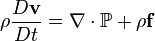
The general form of the Navier–Stokes equations for the conservation of momentum is:

\rho\frac{D\mathbf{v}}{D t} = \nabla\cdot\mathbb{P} + \rho\mathbf{f}

where

  • \rho\ is the fluid density,
  • \frac{D}{D t} is the substantive derivative (also called the material derivative),
  • \mathbf{v} is the velocity vector,
  • \mathbf{f} is the body force vector, and
  • \mathbb{P} is a tensor that represents the surface forces applied on a fluid particle (the comoving stress tensor).

Unless the fluid is made up of spinning degrees of freedom like vortices, \mathbb{P} is a symmetric tensor. In general, (in three dimensions) \mathbb{P} has the form:

\mathbb{P} = \begin{pmatrix} \sigma_{xx} &  \tau_{xy} & \tau_{xz} \\ \tau_{yx} &  \sigma_{yy} & \tau_{yz} \\ \tau_{zx} &  \tau_{zy} & \sigma_{zz} \end{pmatrix}

where

  • \sigma\ are normal stresses,
  • \tau\ are tangential stresses (shear stresses).

The above is actually a set of three equations, one per dimension. By themselves, these aren't sufficient to produce a solution. However, adding conservation of mass and appropriate boundary conditions to the system of equations produces a solvable set of equations.

Continuum mechanics

Fluids are composed of molecules that collide with one another and solid objects. The continuum assumption, however, considers fluids to be continuous. That is, properties such as density, pressure, temperature, and velocity are taken to be well-defined at "infinitely" small points, defining a REV (Reference Element of Volume), at the geometric order of the distance between two adjacent molecules of fluid. Properties are assumed to vary continuously from one point to another, and are averaged values in the REV. The fact that the fluid is made up of discrete molecules is ignored.

The continuum hypothesis is basically an approximation, in the same way planets are approximated by point particles when dealing with celestial mechanics, and therefore results in approximate solutions. Consequently, assumption of the continuum hypothesis can lead to results which are not of desired accuracy. That said, under the right circumstances, the continuum hypothesis produces extremely accurate results.

Those problems for which the continuum hypothesis does not allow solutions of desired accuracy are solved using statistical mechanics. To determine whether or not to use conventional fluid dynamics or statistical mechanics, the Knudsen number is evaluated for the problem. The Knudsen number is defined as the ratio of the molecular mean free path length to a certain representative physical length scale. This length scale could be, for example, the radius of a body in a fluid. (More simply, the Knudsen number is how many times its own diameter a particle will travel on average before hitting another particle). Problems with Knudsen numbers at or above unity are best evaluated using statistical mechanics for reliable solutions.

History of fluid mechanics

The study of fluid mechanics goes back at least to the days of ancient Greece, when Archimedes investigated fluid statics and buoyancy. Medieval Persian & Arab natural philosophers, including Abū Rayhān al-Bīrūnī and Al-Khazini, combined that earlier work with dynamics[1] to presage the later development of fluid dynamics. Rapid advancement in fluid mechanics began with Leonardo da Vinci (observation and experiment), Evangelista Torricelli (barometer), Isaac Newton (viscosity) and Blaise Pascal (hydrostatics), and was continued by Daniel Bernoulli with the introduction of mathematical fluid dynamics in Hydrodynamica (1738). Inviscid flow was further analyzed by various mathematicians (Leonhard Euler, d'Alembert, Lagrange, Laplace, Poisson) and viscous flow was explored by a multitude of engineers including Poiseuille and Gotthilf Heinrich Ludwig Hagen. Further mathematical justification was provided by Claude-Louis Navier and George Gabriel Stokes in the Navier–Stokes equations, and boundary layers were investigated (Ludwig Prandtl), while various scientists (Osborne Reynolds, Andrey Kolmogorov, Geoffrey Ingram Taylor) advanced the understanding of fluid viscosity and turbulence.

Fluid mechanics

Fluid mechanics is the study of fluids and the forces on them. (Fluids include liquids, gases, and plasmas.) Fluid mechanics can be divided into fluid statics, the study of fluids at rest, and fluid dynamics, the study of fluids in motion. It is a branch of continuum mechanics, a subject which models matter without using the information that it is made out of atoms. Fluid mechanics, especially fluid dynamics, is an active field of research with many unsolved or partly solved problems. Fluid mechanics can be mathematically complex. Sometimes it can best be solved by numerical methods, typically using computers. A modern discipline, called computational fluid dynamics (CFD), is devoted to this approach to solving fluid mechanics problems. Also taking advantage of the highly visual nature of fluid flow is particle image velocimetry, an experimental method for visualizing and analyzing fluid flow.