The Navier–Stokes equations (named after Claude-Louis Navier and George Gabriel Stokes) are the set of equations that describe the motion of fluid substances such as liquids and gases. These equations state that changes in momentum (force) of fluid particles depend only on the external pressure and internal viscous forces (similar to friction) acting on the fluid. Thus, the Navier–Stokes equations describe the balance of forces acting at any given region of the fluid.
The Navier–Stokes equations are differential equations which describe the motion of a fluid. Such equations establish relations among the rates of change the variables of interest. For example, the Navier–Stokes equations for an ideal fluid with zero viscosity states that acceleration (the rate of change of velocity) is proportional to the derivative of internal pressure.
This means that solutions of the Navier–Stokes equations for a given physical problem must be sought with the help of calculus. In practical terms only the simplest cases can be solved exactly in this way. These cases generally involve non-turbulent, steady flow (flow does not change with time) in which the Reynolds number is small.
For more complex situations, such as global weather systems like El Niño or lift in a wing, solutions of the Navier–Stokes equations can currently only be found with the help of computers. This is a field of sciences by its own called computational fluid dynamics.
General form of the equation
The general form of the Navier–Stokes equations for the conservation of momentum is:
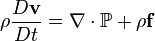
where
 is the fluid density,
 is the substantive derivative (also called the material derivative),
 is the velocity vector,
 is the body force vector, and
 is a tensor that represents the surface forces applied on a fluid particle (the comoving stress tensor).
Unless the fluid is made up of spinning degrees of freedom like vortices, is a symmetric tensor. In general, (in three dimensions) has the form:

where
 are normal stresses,
 are tangential stresses (shear stresses).
The above is actually a set of three equations, one per dimension. By themselves, these aren't sufficient to produce a solution. However, adding conservation of mass and appropriate boundary conditions to the system of equations produces a solvable set of equations.

No comments:
Post a Comment